October 7, 2026
When an accounting platform reaches end of life, replacing the software is only part of the problem.
For one global aircraft lessor, the existing environment had evolved across nearly 100 separate entity files supporting approximately 120 aircraft and engines held through Irish operating companies, special-purpose companies, and joint-venture vehicles. The finance team operated across the United States and Ireland. Reporting depended on spreadsheets. Entity structures had changed over time. And the system carrying the general ledger was being retired by its vendor.
At the same time, the lessor had already modernized another critical part of its operating model. Fly Forward® had been implemented as its lease and asset management platform.
The next step was not simply to buy a new general ledger.
It was to design a finance architecture capable of supporting the business going forward: one accounting backbone, a controlled entity structure, asset-level analysis, consolidated reporting, traceability from the general ledger back to operating transactions, and an implementation process that could withstand scrutiny from management, investors and auditors.
Zeevo Group was engaged to lead the transformation from ERP selection through implementation and integration.
Today, the new ERP is live and operating in parallel with the lessor’s legacy accounting environment.
The challenge: nearly 100 ledgers, one finance function
The legacy environment reflected years of growth and transaction activity.
Each legal entity effectively carried its own accounting file. Processes surrounding those files were supplemented by spreadsheets, institutional knowledge, and manual reconciliation. The model worked, but it made consolidated reporting harder, increased dependency on a small finance team, and created risk as the legacy accounting package approached retirement.
The underlying entity population also was not static.
Before configuration began, the project had to resolve questions involving Irish holding companies, dormant special purpose companies, newly formed engine entities, and jointly owned assets. Nearly a dozen, material entity-scoping decisions were surfaced during the process—decisions that could otherwise have become configuration changes, data-conversion issues or audit questions later.
The lessor, therefore, needed more than an ERP vendor.
It needed a team that understood aircraft leasing, finance, entity structures, accounting data, controls and the operating systems that generate the transactions ultimately posted to the ledger.
Phase 1: Selecting the finance backbone
Rather than starting with demonstrations, the team first built an evidence base. More than eight subject-matter experts across finance, technical, procurement, and operations were interviewed to understand current processes, reporting requirements, pain points, and future-state needs.
Zeevo developed the requirements and gap assessment, built the vendor catalog and shortlist, and compared the total cost of ownership across the viable platforms.
The process had narrowed to two finalists.
An executive working session in Dublin with the lessor’s VP Finance & Operations and COO moved the discussion beyond feature lists. The decision was framed around three questions:
- Could the platform support the required control environment?
- Could it serve as the reporting backbone for a multi-entity aircraft leasing business?
- And did the vendor bring the right delivery model to implement and support it?
The finalists were compared against evidence gathered during the requirements process rather than demonstration performance alone.
During the second phase of selection, Zeevo normalized commercial proposals so management could evaluate the alternatives on a like-for-like basis. Licensing, users, analytical dimensions, add-ons and contractual escalation clauses were assessed alongside validation sessions covering banking, intercompany accounting and reporting.
Delivery capability was treated as part of the product decision.
The selected vendor was required to identify its delivery lead, and onsite training in the United States was incorporated into the agreement as a condition of the engagement.
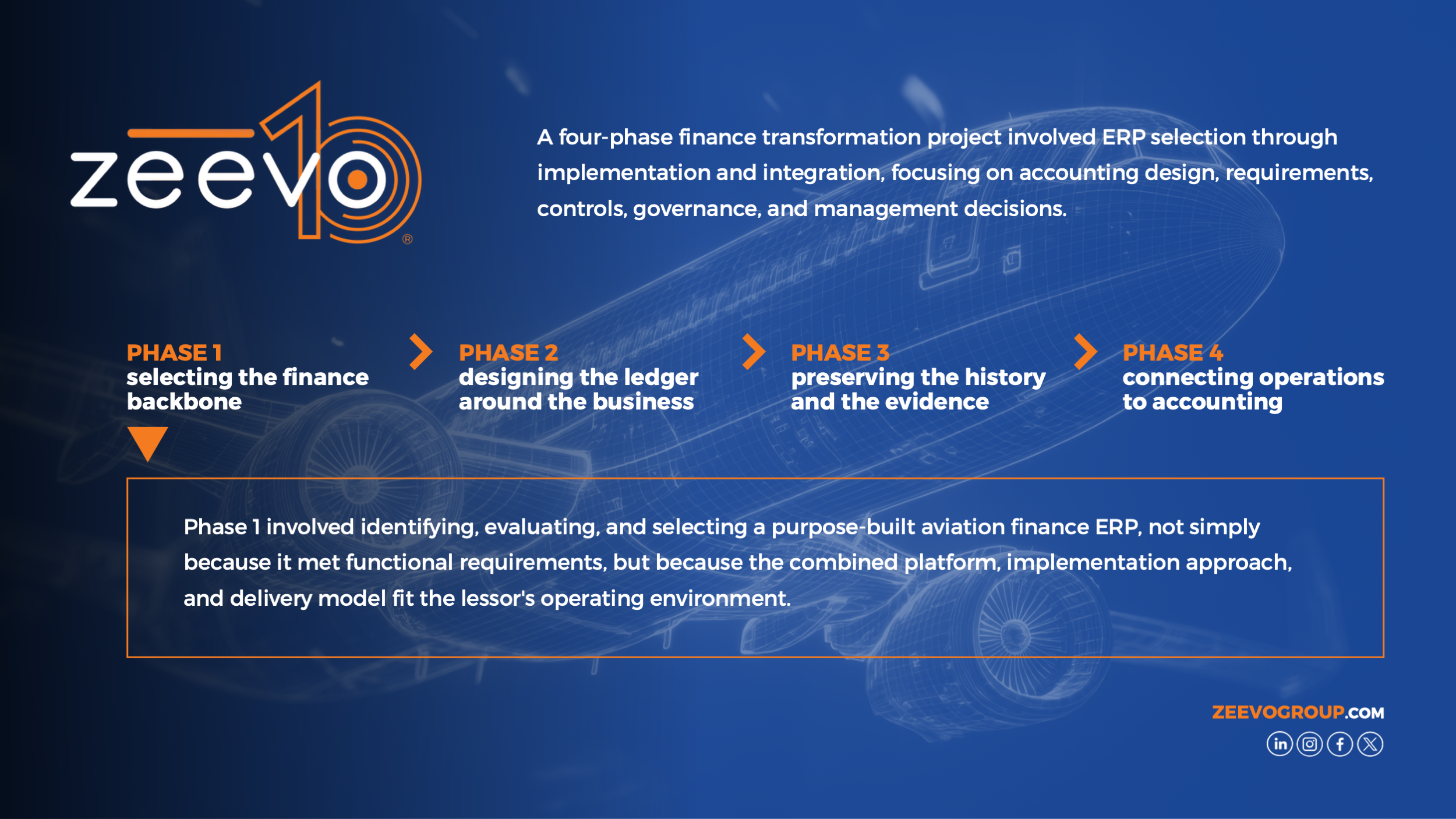
The result was the selection of a purpose-built aviation finance ERP—not simply because it met functional requirements, but because the combined platform, implementation approach and partner model fit the lessor’s operating environment.
Phase 2: Designing the ledger around the business
Implementation formally kicked off, with weekly project calls and configuration workshops beginning the following week. The detailed project plan was agreed and supported by a steering committee charter establishing governance, responsibilities, and escalation paths.
One of the first major workstreams was the chart of accounts.
The objective was not to reproduce nearly 100 legacy accounting files inside a new system.
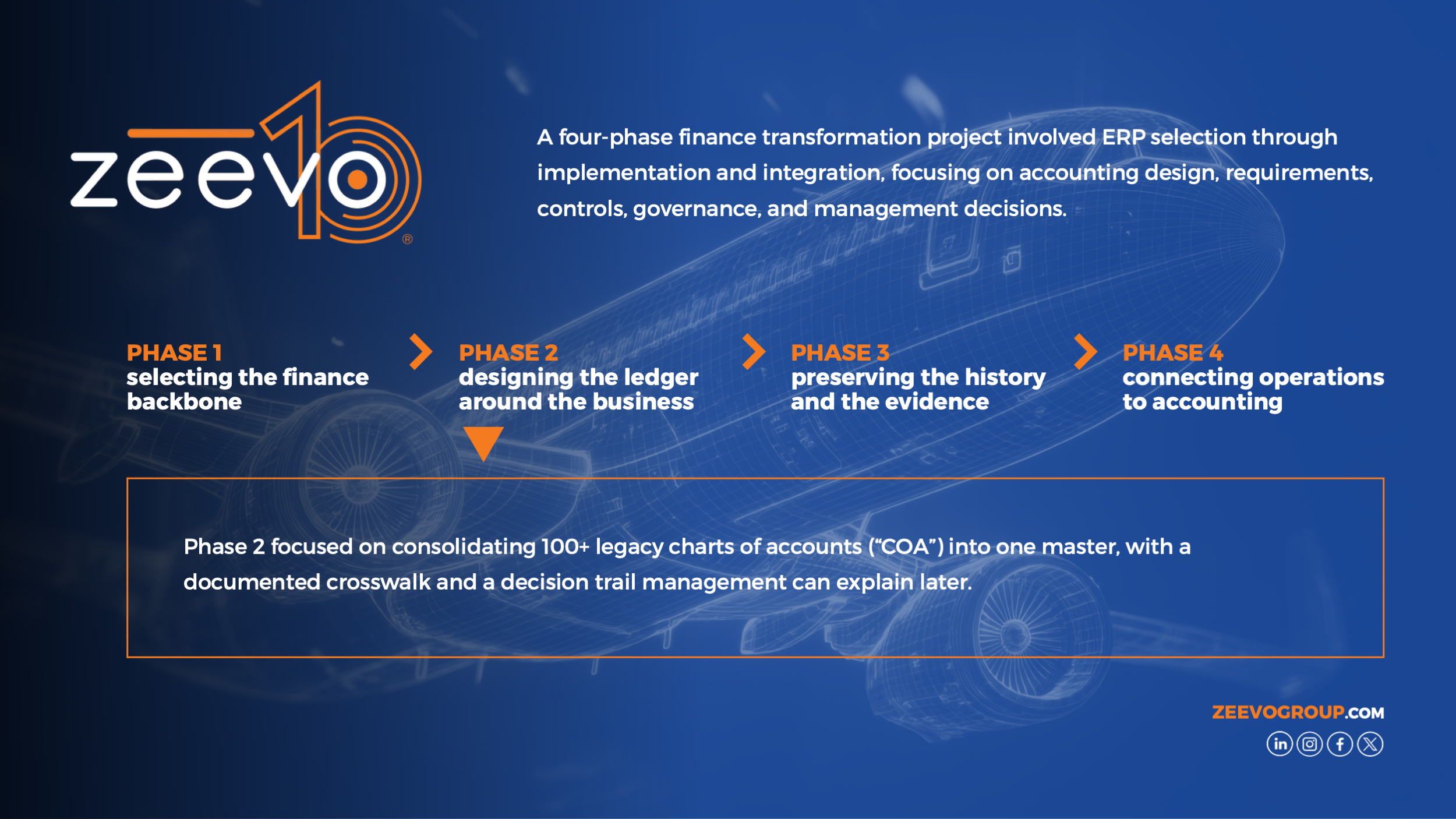
Zeevo first consolidated the existing account structures into a single analytical view. From there, the team designed a master chart of accounts and developed entity-level crosswalks between legacy accounts and the future-state structure.
Each mapping carried a confidence assessment so exceptions could be reviewed rather than buried inside a conversion workbook.
The team also created an entity scope register covering the legal entities expected to enter the new ERP, with a named approver attached to material scope decisions.
That discipline mattered.
During the process, nearly a dozen questions with potential downstream accounting or system implications were identified and resolved before build—including the treatment of holding companies, dormant SPCs, new engine entities and jointly owned assets.
The work created something more valuable than a cleaner chart of accounts: a documented accounting architecture and a decision trail that management could explain later.
Phase 3: Preserving the history and the evidence
Data conversion was designed around the same principle.
The objective was not merely to achieve opening balances that tied.
It was to preserve the pathway back to the source.
Opening balances had been loaded for every in-scope entity, while legacy transaction history had been exported.
Source registers documented what was received, processed, and loaded. Decisions were recorded as they were made. Zeevo also prepared a methodology memorandum describing the conversion approach and controls so the implementation record itself could serve as audit evidence.
That audit posture was intentional from day one.
Rather than reconstructing the story after implementation, the project built the evidence as the work occurred.
Phase 4: Connecting operations to accounting
The lessor already had an operating system for its lease portfolio.
Fly Forward had been managing lease and asset activity since mid-2025. The ERP implementation, therefore, created the opportunity to establish a clear system architecture:
Fly Forward as the lease and asset management (and accounts receivable) sub-ledger.
The new ERP as the accounting book of record.
Zeevo designed the integration between the two platforms.
The model automates accounting journals generated from billing, cash receipts and payment allocations in Fly Forward. Transactions are validated in batches before posting and can carry as many as 10 analytical dimensions into the general ledger.
The design also preserves drill-back.
Rather than leaving finance with an aggregated journal and a reconciliation spreadsheet, the architecture allows the accounting entry to retain a traceable path back to the underlying operating transaction.
The Fly Forward journal integration was built against the live ERP code structure and approved analytical dimensions, rather than against a temporary mapping.
That distinction is important.
The integration was not an interface added after two systems had been implemented independently. It was designed as part of the finance architecture.
Three workstreams, one transformation
Throughout the implementation, Zeevo ran three workstreams simultaneously.
Client advisory focused on accounting design, requirements, controls, governance, and management decisions.
Data processing addressed the entity population, historical files, chart of accounts rationalization and crosswalks, opening balances, and evidence of conversion.
Vendor coordination connected the lessor’s requirements with the ERP’s aviation product team and implementation resources.
Running those workstreams together allowed issues to be resolved where they originated.
A question about an entity could affect the chart of accounts, conversion scope, intercompany configuration, reporting and Fly Forward dimensional coding at the same time. Treating those activities as one transformation reduced the risk of solving the same problem differently in five places.
From implementation to parallel run
The program had moved through user acceptance testing and training and quickly shifted to a parallel run
The master accounting structure was established. The entity population had been worked through. Historical data had been extracted, converted, and populated, including opening balances loaded, and the Fly Forward journal integration had been built against the live ERP configuration.
The new general ledger is now live.
Rather than immediately switching off the retiring accounting package, the lessor is operating the new ERP in parallel with the legacy environment.
That parallel run provides something more useful than a ceremonial go-live date: a period in which finance can confidently validate accounting results, reporting, interfaces, and operating procedures against the system it already knows.
It also enables management and the project team to resolve differences while the legacy evidence remains readily available.
The objective is not simply to prove that the balances agree.
It is to demonstrate that the new environment can support the accounting result with a stronger structure, greater traceability, optimized processes, and better analytical capability before the legacy platform is retired.
Why this model matters beyond one lessor
Aircraft leasing finance functions often manage complexity disproportionate to their headcount.
A relatively small team may support dozens of legal entities, assets operating across multiple jurisdictions, external investors, financing structures, joint ventures, and reporting obligations—all while maintaining asset-level visibility and responding to auditors, lenders, and management.
That operating model is familiar across the aviation finance market, including lessors, funds, and investment platforms active in Latin America.
The technology question, therefore, cannot be separated from the operating-model question.
Moving from fragmented desktop ledgers to an aviation-grade ERP provides the foundation, but the value comes from connecting the pieces: legal entities, accounting policies, asset-level dimensions, historical data, operating transactions, reporting requirements, and the control environment.
For this lessor, the architecture is straightforward:
- One accounting backbone.
- Fly Forward as the operating accounts receivable sub-ledger.
- A traceable path from the aircraft transaction to the general ledger.
- And, before the old environment is retired, a parallel run proving that the new architecture works in the real finance operation.
Getting there required considerably more than installing software.
It required treating finance transformation as exactly that—a transformation.
About Zeevo Group LLC:
Zeevo Group LLC (“Zeevo”) provides business, finance and information technology consulting services and products to a broad range of clients representing such key industries as aircraft leasing, technology and consumer products. zeevogroup.com
Media Contact:
Direct: +1 760 933 8607
contactus@zeevogroup.com
RECENT NEWS